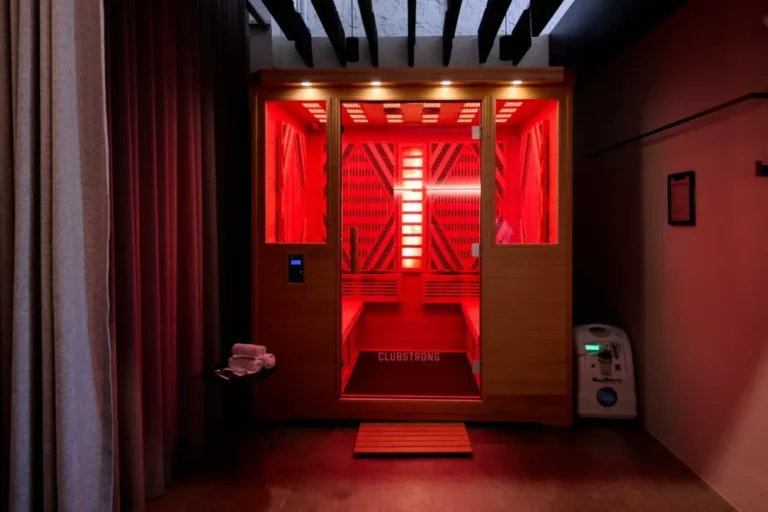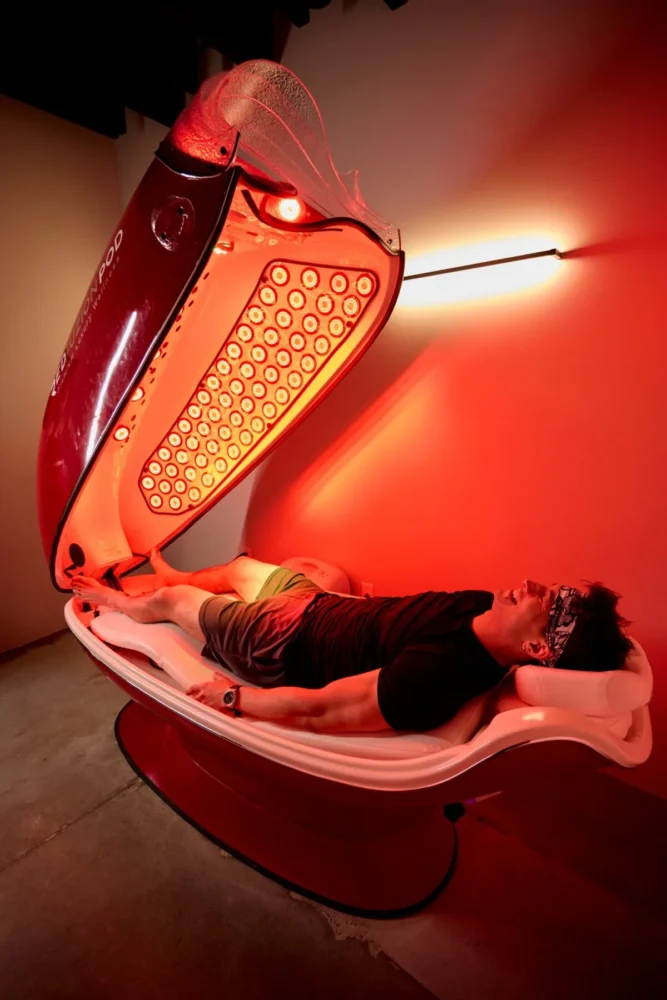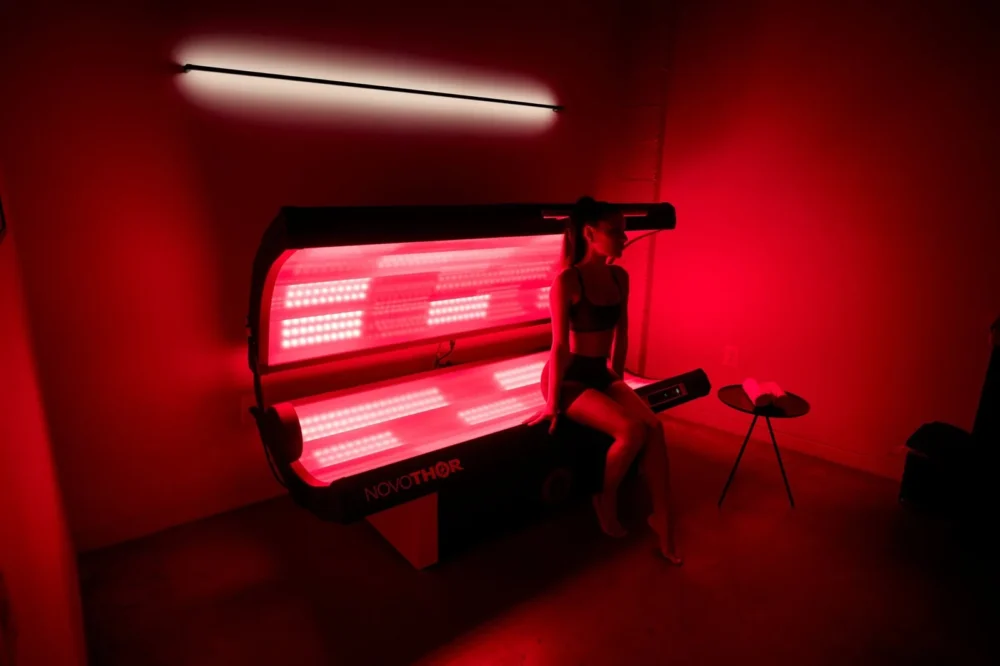
Red light therapy, also called photobiomodulation, uses red and near-infrared light to support cellular repair, ease soreness, and speed muscle recovery. Among light-based and temperature-based recovery methods, it has some of the stronger evidence for the markers that track recovery: reduced muscle damage, lower soreness, and faster return of strength. It works through a photochemical effect, where light-absorbing components in your cells use the energy to repair and regenerate. A full-body delivery system treats everything at once in a short session. City Fitness Revive offers full-body red light therapy.
What red light therapy is
Red light therapy, known in research literature as photobiomodulation, exposes your body to red and near-infrared wavelengths. It is not heat therapy, and the light does not burn.
The mechanism is photochemical rather than thermal. Light-absorbing components inside your cells, particularly in the mitochondria, absorb specific wavelengths and use that energy to support repair processes.
Does it work?
Systematic reviews of phototherapy applied around exercise report reduced markers of muscle damage, less soreness, and faster return of strength compared with placebo. Comparative work has found photobiomodulation performed as well as or better than cold therapy on several of those same markers.
What it is good for
Muscle recovery and soreness. The best-supported use. Applied after hard training, it can reduce how sore you feel and how long reduced strength lingers.
Inflammation and joint discomfort. Evidence for localized pain and stiffness, particularly around joints that get repeatedly loaded.
It does not interfere with muscle growth. Unlike some types of cold exposure, red light has not been shown to work against strength adaptations, which makes it easy to use on lifting days without having to time it carefully.
How to use it
Ten to 20 minutes per session, two to four times a week, is what most protocols suggest. Expose skin where practical, since clothing blocks the wavelengths.
Who should be cautious
Talk to your doctor first if you are pregnant, have a condition that makes you sensitive to light, or take a photosensitizing medication. Some antibiotics, acne treatments, diuretics, and other drugs increase light sensitivity. Use the eye protection provided; do not look directly at the light source. If you have a history of skin cancer or an active skin lesion, clear it with a clinician before starting.
FAQ
Does red light therapy work?
For muscle recovery and soreness, the evidence points to: reduced muscle damage markers, less soreness, and faster strength return compared with placebo.
What does red light therapy do for muscle recovery?
It supports cellular repair in the tissue you just trained, which shows up as reduced soreness and a faster return of strength in the days after a hard session.
How often should you use red light therapy?
Two to four sessions a week, 10 to 20 minutes each, is the usual range.
Is red light therapy the same as an infrared sauna?
No. A sauna works by heat, raising your core temperature. Red light therapy works by a photochemical effect at specific wavelengths and does not rely on heating you up.
About this series: This article is part of the City Fitness Revive recovery series and is for educational purposes only. It is not medical advice and does not create a clinician-patient relationship. Revive services are not intended to diagnose, treat, cure, or prevent any disease or medical condition. Talk with your doctor or another qualified clinician before starting or changing a recovery routine, especially if you are pregnant, have any health condition, or take any medication.
Recovery treatments are not right for everyone. Heat, extreme cold, compression, percussion, supplemental oxygen, and light therapy can be unsafe for people with certain conditions. These include heart disease or high, low, or unstable blood pressure; blood clots, a history of DVT, or circulation problems such as Raynaud’s; respiratory conditions; conditions that reduce your ability to sense heat, cold, or pain, such as neuropathy; sensitivity to light or heat, or a medication that causes it; a history of skin cancer or an active skin lesion; use of blood thinners or a bleeding disorder; and open wounds, skin infections, illness, or a recent injury or surgery. If any of these apply to you, get your doctor’s approval first. Do not use Revive services after drinking alcohol or while dehydrated. Stop any session right away if you feel pain, dizziness, numbness, tingling, or otherwise unwell. Always follow posted instructions and Team Member guidance, including the required protective gear and eye protection.
Research described in this series summarizes average findings from published studies. Individual experiences vary, and session lengths and frequencies are general guidelines, not personal recommendations.
Sources
- Leal-Junior, E. C. P., Vanin, A. A., et al. (2015). Effect of phototherapy (low-level laser therapy and light-emitting diode therapy) on exercise performance and markers of exercise recovery: a systematic review with meta-analysis. Lasers in Medical Science, 30, 925-939. doi.org/10.1007/s10103-013-1465-4
- Vanin, A. A., Verhagen, E., Barboza, S. D., Costa, L. O. P., & Leal-Junior, E. C. P. (2018). Photobiomodulation therapy for the improvement of muscular performance and reduction of muscular fatigue associated with exercise in healthy people: a systematic review and meta-analysis. Lasers in Medical Science, 33, 181-214. doi.org/10.1007/s10103-017-2368-6