Whole-body cryotherapy surrounds your body with ultra-cold air for about three minutes to ease muscle soreness and support recovery after hard training. The evidence is strongest for reduced soreness and improved recovery. One timing note: cold applied immediately after strength training may work against muscle growth, so if building size is a goal, use cold on rest days instead. City Fitness Revive offers whole-body cryotherapy.
What happens in a cryotherapy session
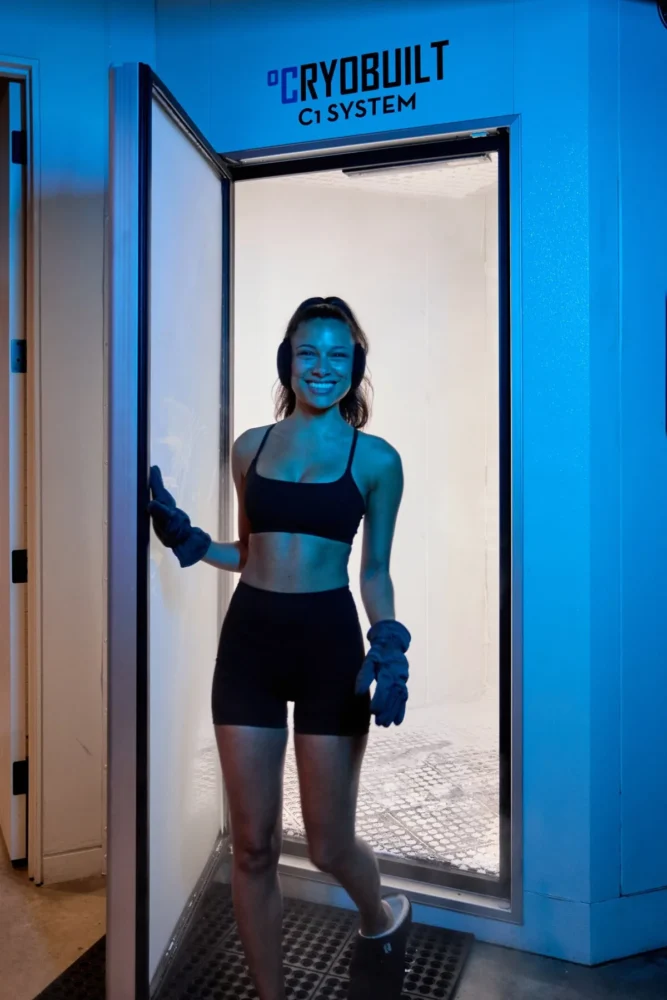
You step into a chamber, and for roughly three minutes the air around you drops to somewhere near minus 200 degrees Fahrenheit. Your head stays above the chamber or you wear protective gear, depending on the unit.
Because it is dry circulating air rather than water, the sensation is sharp but more tolerable than an ice bath, with most people finding the first 30 seconds the hardest part.
What the evidence supports
People who work cryo into their wellbeing routines report feeling less sore and more refreshed after sessions, plus better sleep and mood!
Cryotherapy vs a cold plunge
Cryotherapy and a cold plunge are both cold exposure, but they are not quite the same experience.
Cryotherapy is dry air, roughly three minutes, extremely cold, and primarily affects the skin and surface tissue because the exposure is so short. It is faster, drier, and easier to tolerate.
A cold plunge is water, usually 5 to 15 minutes, far less cold in absolute terms but a much more efficient conductor. Water pulls heat out of you roughly 25 times faster than air, so a plunge produces a deeper and more sustained drop in tissue temperature.
Cryotherapy gives the sharper, shorter stimulus; a plunge gives the deeper one.
The timing rule for lifters
If your primary goal is building muscle, consider not using cold immediately after strength training. A 2024 meta-analysis found a modest negative effect on muscle growth when cold was applied within about 15 minutes of lifting.
How to use it
Three minutes is a full session, and longer is not better. Two to three sessions a week suits most people. Go in dry, and follow the staff instructions on protective gear exactly.
Who should be cautious
Whole-body cryotherapy is not FDA-cleared for treating any medical condition, and the FDA has noted that the effects of extreme cold on blood pressure, heart rate, and metabolism are not fully characterized. Talk to your doctor first if you are pregnant, have cardiovascular disease, uncontrolled high or low blood pressure, Raynaud’s phenomenon, a cold allergy, peripheral neuropathy, or any condition affecting circulation or your ability to sense temperature. Do not use it if you have open wounds or are unwell. Follow all staff instructions on protective gear; frostbite and burns are documented risks of improper use.
FAQ
What does whole-body cryotherapy do?
It exposes you to ultra-cold air for about three minutes, which most people experience as reduced soreness and a refreshed feeling afterward.
Is cryotherapy better than a cold plunge?
They deliver different stimuli. Cryotherapy is drier, shorter, and sharper, with most of its effect at the surface. A cold plunge runs longer and cools tissue more deeply.
How long is a cryotherapy session?
About three minutes. Longer sessions do not produce better results.
Can cryotherapy affect muscle growth?
The muscle-growth concern comes mostly from cold water immersion research, where cold within about 15 minutes of lifting showed a modest negative effect on growth. Whole-body cryotherapy has less evidence against it, and one six-week trial found no reduction in strength gains. If maximizing muscle size is your goal, the conservative approach is to use cold on rest days.
About this series: This article is part of the City Fitness Revive recovery series and is for educational purposes only. It is not medical advice and does not create a clinician-patient relationship. Revive services are not intended to diagnose, treat, cure, or prevent any disease or medical condition. Talk with your doctor or another qualified clinician before starting or changing a recovery routine, especially if you are pregnant, have any health condition, or take any medication.
Recovery treatments are not right for everyone. Heat, extreme cold, compression, percussion, supplemental oxygen, and light therapy can be unsafe for people with certain conditions. These include heart disease or high, low, or unstable blood pressure; blood clots, a history of DVT, or circulation problems such as Raynaud’s; respiratory conditions; conditions that reduce your ability to sense heat, cold, or pain, such as neuropathy; sensitivity to light or heat, or a medication that causes it; a history of skin cancer or an active skin lesion; use of blood thinners or a bleeding disorder; and open wounds, skin infections, illness, or a recent injury or surgery. If any of these apply to you, get your doctor’s approval first. Do not use Revive services after drinking alcohol or while dehydrated. Stop any session right away if you feel pain, dizziness, numbness, tingling, or otherwise unwell. Always follow posted instructions and Team Member guidance, including the required protective gear and eye protection.
Research described in this series summarizes average findings from published studies. Individual experiences vary, and session lengths and frequencies are general guidelines, not personal recommendations.
Sources
- Pinero, A., et al. (2024). Throwing cold water on muscle growth: a systematic review with meta-analysis of the effects of postexercise cold water immersion on resistance training-induced hypertrophy. European Journal of Sport Science. doi.org/10.1002/ejsc.12074
- Haq, A., Ribbans, W. J., Hohenauer, E., & Baross, A. W. (2022). The effect of repetitive whole body cryotherapy treatment on adaptations to a strength and endurance training programme in physically active males. Frontiers in Sports and Active Living. doi.org/10.3389/fspor.2022.834386
- US Food and Drug Administration. Whole Body Cryotherapy (WBC): A “Cool” Trend that Lacks Evidence, Poses Risks. Consumer update. Archived copy