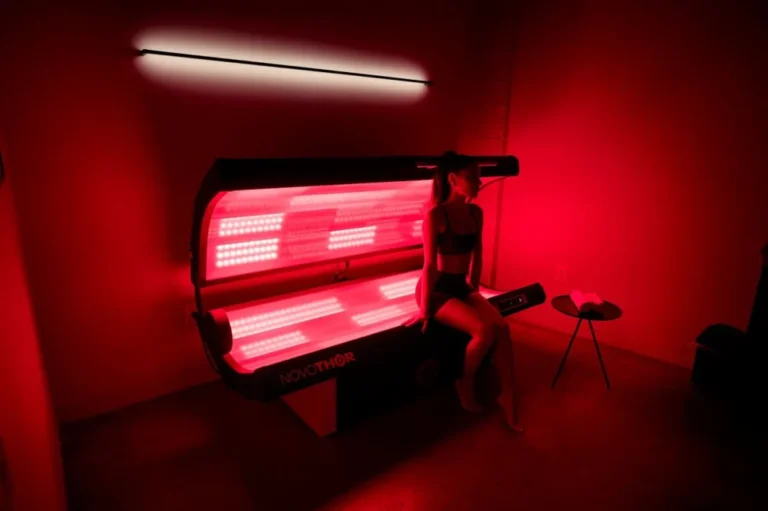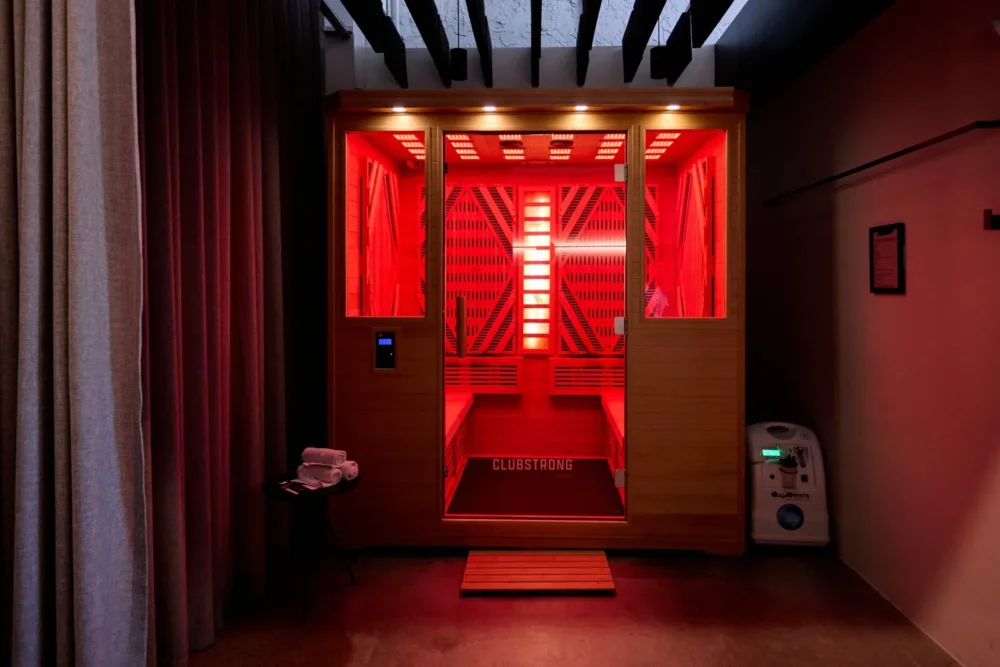
An infrared sauna uses infrared light to heat your body directly rather than heating the air around you, so sessions feel more comfortable than a traditional sauna while still raising your core temperature. Research suggests a post-workout infrared sauna session can reduce perceived muscle soreness, support circulation, and aid relaxation, and it works best as a regular part of your training week. Most people use one for 15 to 20 minutes after training. Unlike some types of cold exposure, heat has not been shown to interfere with muscle growth. Select City Fitness Revive saunas are oxygen-infused.
What makes an infrared sauna different
A traditional sauna heats the air, and the hot air heats you. An infrared sauna skips a step: infrared light warms your body directly.
The practical difference is comfort. A traditional sauna typically runs between 160 and 200 degrees Fahrenheit, which many people find hard to tolerate for long. An infrared sauna runs cooler, often between 120 and 150 degrees, while still raising core temperature and producing a real sweat. That usually means a longer, more comfortable session, and it puts the sauna within reach of people who find traditional heat less bearable.
What it does for recovery
The most consistent finding is reduced soreness. Heat increases blood flow to skeletal muscle and skin, and a meta-analysis of 32 randomized trials found heat therapy reduced delayed onset muscle soreness pain both within the first 24 hours and beyond it.
What to expect
Judge an infrared sauna on how you feel and train in the days after, not on the scale. The weight that comes off during a sauna session is practically just water weight, and you will replace it as soon as you rehydrate, which is exactly what you should do.
What it does beyond the muscles
Recovery is not only muscular. A 2026 study of regular sauna users found they described their sauna time mainly in terms of stress relief, emotional regulation, and social connection. Several pointed to the absence of phones and interruptions as part of why it felt great. A separate study measuring mood before and after a 20-minute session recorded higher vigor and lower tension, fatigue, and confusion afterward.
What oxygen-infused means
Some City Fitness Revive saunas add supplemental oxygen to the cabin, which members generally describe as making a hot session feel more breathable and less stifling.
How to use one
Fifteen to 20 minutes after training is the standard dose. Hydrate before and after, start shorter if you are new to it, and get out if you feel lightheaded.
Who should be cautious
Talk to your doctor before using an infrared sauna if you are pregnant, have cardiovascular disease, low or unstable blood pressure, or a condition that affects your ability to sweat or sense heat. Alcohol and some medications, including those that affect blood pressure or hydration, change how your body handles heat. Skip the sauna if you are ill, dehydrated, or feeling unwell.
FAQ
What are the benefits of an infrared sauna?
Reduced muscle soreness, increased circulation, and relaxation are the best-supported benefits, and they build up when you use it consistently rather than once in a while.
Is an infrared sauna good for muscle recovery?
Yes, for soreness and comfort. A meta-analysis of 32 randomized trials found heat therapy reduced delayed onset muscle soreness pain.
How long should you sit in an infrared sauna?
Fifteen to 20 minutes is the typical session. Start at 10 if you are new to it.
Infrared sauna vs traditional sauna, what’s the difference?
A traditional sauna heats the air around you at a higher temperature. An infrared sauna heats your body directly at a lower air temperature, which most people find easier to tolerate for a full session.
Should you use an infrared sauna before or after a workout?
After. Heat before training can raise your core temperature and increase cardiovascular strain during the session itself, which is not what you want going into hard work.
About this series: This article is part of the City Fitness Revive recovery series and is for educational purposes only. It is not medical advice and does not create a clinician-patient relationship. Revive services are not intended to diagnose, treat, cure, or prevent any disease or medical condition. Talk with your doctor or another qualified clinician before starting or changing a recovery routine, especially if you are pregnant, have any health condition, or take any medication.
Recovery treatments are not right for everyone. Heat, extreme cold, compression, percussion, supplemental oxygen, and light therapy can be unsafe for people with certain conditions. These include heart disease or high, low, or unstable blood pressure; blood clots, a history of DVT, or circulation problems such as Raynaud’s; respiratory conditions; conditions that reduce your ability to sense heat, cold, or pain, such as neuropathy; sensitivity to light or heat, or a medication that causes it; a history of skin cancer or an active skin lesion; use of blood thinners or a bleeding disorder; and open wounds, skin infections, illness, or a recent injury or surgery. If any of these apply to you, get your doctor’s approval first. Do not use Revive services after drinking alcohol or while dehydrated. Stop any session right away if you feel pain, dizziness, numbness, tingling, or otherwise unwell. Always follow posted instructions and Team Member guidance, including the required protective gear and eye protection.
Research described in this series summarizes average findings from published studies. Individual experiences vary, and session lengths and frequencies are general guidelines, not personal recommendations.
Sources
- Wang, Y., Li, S., Zhang, Y., Chen, Y., Yan, F., Han, L., & Ma, Y. (2021). Heat and cold therapy reduce pain in patients with delayed onset muscle soreness: a systematic review and meta-analysis of 32 randomized controlled trials. Physical Therapy in Sport, 48, 177-187. doi.org/10.1016/j.ptsp.2021.01.004
- Magatova, N., Hunt, D. F., & Lay, J. (2026). Mental well-being and regular sauna bathing: a phenomenological study of psychological experiences and perceived impact. Qualitative Health Research. doi.org/10.1177/10497323261462404
- Podstawski, R., Boryslawski, K., Jozefacka, N. M., et al. (2024). The influence of extreme thermal stress on the physiological and psychological characteristics of young women who sporadically use the sauna. Frontiers in Public Health, 11, 1303804. doi.org/10.3389/fpubh.2023.1303804